Stainless steel tube selection affects performance, service life, and long-term operating costs. Buyers often compare seamless tube and welded stainless options to determine which solution delivers the right balance of strength, corrosion resistance, and cost. This guide explains how stainless steel tubes are produced, how they perform in real applications, and how to choose the right tube for your project.
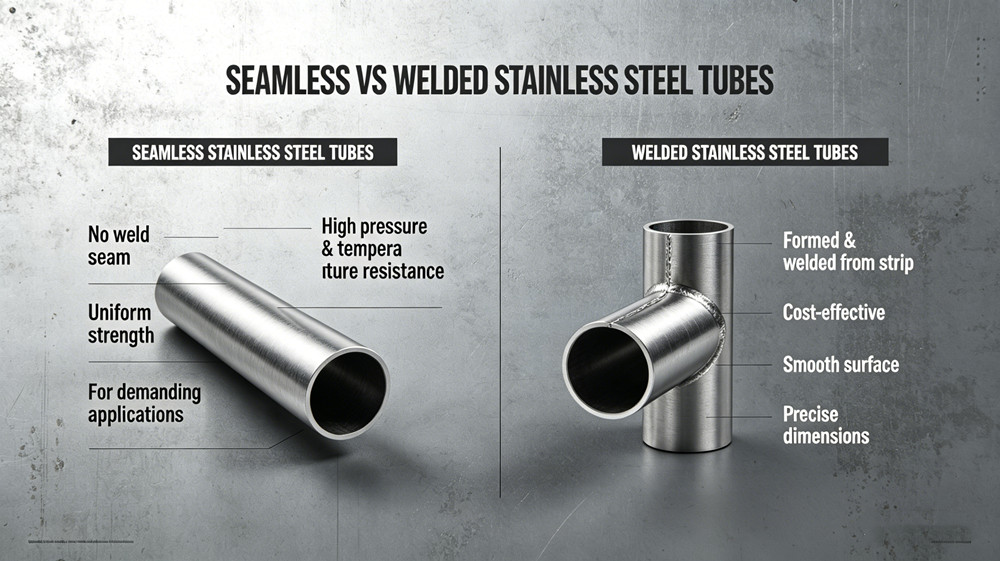
Seamless stainless steel tube is produced without a weld seam, offering uniform strength, higher pressure tolerance, and reliable corrosion resistance.
Welded tube is made by forming and welding stainless steel strip, providing cost efficiency, consistent wall thicknesses, and wide availability.
The best choice depends on pressure level, corrosion exposure, tolerances, and budget.
A stainless steel tube is a hollow cylindrical product used to transport fluids, support structures, and protect equipment. Stainless steel tubes are valued for:
They are widely used in oil & gas, chemical processing, food equipment, water treatment, construction, and energy industries.
A seamless tube starts from a solid stainless steel billet. The billet is heated and pierced to create a hollow shell, then elongated and rolled to the required diameter and wall thicknesses.
Key characteristics:
Because there is no weld seam, seamless stainless steel tubes are often selected for high-pressure, high-temperature, and safety-focused applications.
Welded stainless products are made from stainless steel coil or strip. The strip is formed into a round shape and welded along the seam. After welding, the tube is heat-treated and finished to meet standards.
Key characteristics:
Modern welding technologies allow welded tube products to meet strict industrial requirements.
| Feature | Seamless Tube | Welded Tube |
|---|---|---|
| Manufacturing | Pierced from billet | Formed and welded from strip |
| Strength | Uniform strength across tube | Strong weld seam after treatment |
| Pressure capability | Higher pressure tolerance | Suitable for medium pressure |
| Corrosion resistance | Excellent resistance to corrosion | Very good resistance to corrosion |
| Wall thicknesses | Wide range, including thick walls | Consistent and precise |
| Surface finish | Slightly rougher | Smooth and uniform |
| Cost | Higher | More economical |
| Availability | Smaller production volumes | Large-scale production |
Limitations
Limitations
Both seamless and welded stainless steel tubes provide strong resistance to corrosion, especially when the correct grade is selected.
Typical corrosion-resistant grades include:
The final performance depends more on material grade and finishing than on manufacturing method alone.
When selecting between seamless and welded tube, consider:
High pressure or extreme heat → choose seamless tube.
Aggressive environments → choose higher alloy or seamless options.
Large projects with moderate requirements → welded stainless tubes offer strong value.
Visible or hygienic applications → welded tube often provides a smoother finish.
Very thick walls → seamless tube is often preferred.
Seamless tube and welded stainless solutions both deliver high quality performance when matched to the right application. Seamless tubes offer strength and reliability in demanding environments, while welded tube products provide cost efficiency, consistent dimensions, and excellent surface quality. Understanding your operating conditions, corrosion exposure, and budget helps ensure the best long-term choice.
Seamless tube offers uniform strength without a weld seam, making it suitable for higher pressure and temperature environments.
Yes. Modern welded stainless manufacturing includes heat treatment and testing to ensure durability and resistance to corrosion.
Both types can provide excellent corrosion resistance when the correct stainless steel grade is selected.
Seamless production requires more material and processing steps, which increases manufacturing cost.
Welded tube works well in medium-pressure systems. High-pressure systems typically use seamless tube.
Oil & gas, chemical processing, food processing, pharmaceuticals, water treatment, and construction are major users of stainless steel tubes.