When selecting electropolished (EP) tubing for high-purity applications, buyers often focus on material grade, dimensions, and pressure ratings. However, another factor deserves equal attention—surface roughness.
The internal surface of an EP tube directly affects cleanliness, corrosion resistance, fluid flow, and system reliability. In industries such as semiconductor manufacturing, pharmaceuticals, biotechnology, and analytical laboratories, even microscopic surface imperfections can influence process performance.
This guide explains what surface roughness is, how it is measured, why it matters in EP tubes, and how it affects the quality of electropolished stainless steel tubing.
Surface roughness is important in EP tubes because a smoother internal surface reduces particle retention, improves cleanliness, enhances corrosion resistance, supports easier cleaning, and provides more consistent fluid and gas flow. These benefits make electropolished tubing suitable for ultra high purity applications such as semiconductor manufacturing and pharmaceutical production.
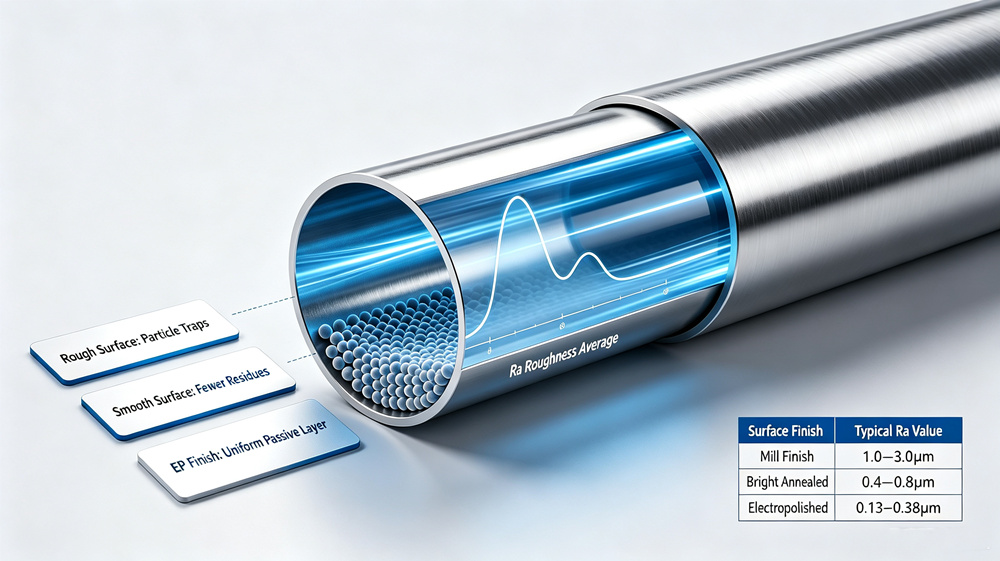
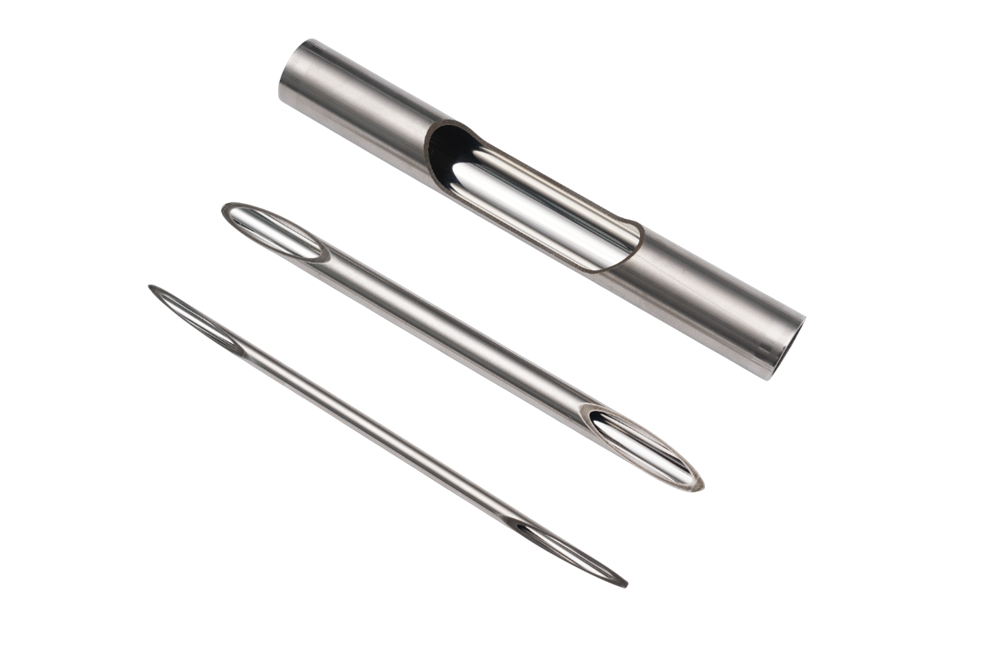
Surface roughness refers to the microscopic peaks and valleys that remain on a metal surface after manufacturing.
Even a polished stainless steel tube appears smooth to the naked eye, but under magnification, small irregularities are still present.
These microscopic features can affect:
The smoother the surface, the fewer places contaminants can remain.
Surface roughness is commonly measured using Ra (Roughness Average).
Ra represents the average height of microscopic surface irregularities.
Typical values include:
| Surface Finish | Typical Ra Value |
|---|---|
| Mill Finish | 1.0–3.0 μm |
| Bright Annealed (BA) | 0.4–0.8 μm |
| Electropolished (EP) | 0.13–0.38 μm |
Some ultra-high-purity systems may require even lower Ra values depending on customer specifications.
Electropolishing is an electrochemical finishing process.
Unlike mechanical polishing, which removes material by abrasion, electropolishing removes a very thin layer of metal through controlled electrochemical dissolution.
During the process:
The result is a cleaner and more consistent surface finish.
The inside of a tube is where gases or liquids flow.
If the internal surface is rough, it may trap:
A smoother surface helps reduce these risks while improving overall system cleanliness.
For high-purity applications, maintaining a clean internal surface is often one of the primary design requirements.
Surface roughness also influences corrosion performance.
Rough surfaces contain more microscopic crevices where moisture and chemicals can accumulate.
These locations may become starting points for:
Electropolishing produces a chromium-rich passive oxide layer that improves the natural corrosion resistance of stainless steel.
As a result, EP tubing generally performs better in demanding environments than standard mechanically finished tubing.
Particle contamination is a concern in many industries.
Rough surfaces are more likely to release tiny metal particles during operation.
A smoother electropolished surface helps reduce:
This is one reason EP tubing is widely used in clean manufacturing environments.
Cleaning solutions flow more easily across smooth surfaces.
Because fewer contaminants remain trapped in microscopic valleys, electropolished tubing is generally easier to clean than tubing with rougher finishes.
This advantage helps reduce cleaning time and supports more consistent sanitation procedures.
Surface roughness can influence how fluids and gases move through a tube.
Although the effect is small in many industrial systems, smoother surfaces may provide:
These benefits are especially valuable in high-purity gas distribution systems.
Semiconductor fabrication requires extremely clean process gases.
Electropolished tubing helps minimize particle contamination and supports stable gas delivery.
Pharmaceutical systems require hygienic piping that is easy to clean and resistant to contamination.
Low surface roughness supports these requirements.
Bioprocess equipment often transports sensitive liquids.
Smooth tubing surfaces help reduce contamination risks while improving cleaning efficiency.
Sanitary processing equipment benefits from smooth stainless steel surfaces that are easier to wash and maintain.
Ultra-high-purity gas distribution systems depend on clean tubing with controlled surface characteristics.
EP tubing is commonly selected for these applications.
Several industry standards define surface finish requirements for stainless steel tubing.
Common examples include:
Depending on the application, customers may specify maximum Ra values to ensure consistent product quality.
| Feature | Bright Annealed Tube | Electropolished Tube |
| Surface Roughness | Higher | Lower |
| Surface Finish | Smooth | Ultra Smooth |
| Corrosion Resistance | Good | Better |
| Particle Retention | Higher | Lower |
| Cleaning | Good | Easier |
| High-Purity Applications | Suitable | Preferred |
Electropolished tubing provides additional surface refinement beyond the bright annealing process.
When requesting quotations from suppliers, buyers should clearly specify:
Clear specifications help ensure the delivered product matches application requirements.
Professional manufacturers inspect surface quality using specialized roughness measuring instruments.
Typical quality inspections include:
Many suppliers also provide inspection reports with shipment documentation.
Surface roughness describes the microscopic peaks and valleys on a material's surface. It is commonly measured using Ra (Roughness Average).
A smoother surface helps reduce particle retention, improves corrosion resistance, supports easier cleaning, and provides cleaner fluid and gas flow.
Most electropolished tubing has an Ra value between approximately 0.13 μm and 0.38 μm, depending on manufacturing specifications.
Yes. Electropolishing removes a thin layer of metal, reducing microscopic surface irregularities and creating a smoother finish.
Semiconductor manufacturing, pharmaceuticals, biotechnology, food processing, medical gas systems, and high-purity chemical industries commonly specify low surface roughness.
Not necessarily. The required Ra value depends on the application and applicable industry standards. Buyers should specify the appropriate surface finish based on their process requirements.
Manufacturers use surface roughness testers that measure Ra values according to recognized international standards.
Surface roughness is one of the most important characteristics of electropolished stainless steel tubing. A smooth internal surface helps improve cleanliness, corrosion resistance, cleaning efficiency, and fluid flow while reducing particle retention and contamination risks.
For industries such as semiconductor manufacturing, pharmaceutical production, biotechnology, and other ultra-high-purity applications, selecting EP tubes with the appropriate surface finish helps support reliable and consistent system performance.
When evaluating suppliers, always review the specified Ra value, applicable industry standards, inspection methods, and quality documentation to ensure the tubing meets your project's technical requirements.