Electropolished (EP) tubing is widely used in industries that require extremely clean fluid and gas delivery systems. It is commonly found in semiconductor manufacturing, pharmaceutical production, biotechnology, and other ultra high purity UHP applications.
Unlike standard stainless steel tubes, electropolished stainless steel tubing goes through additional manufacturing and finishing steps to improve cleanliness, corrosion resistance, and surface quality. The result is a smooth, bright, and contamination-free internal surface that meets demanding industry requirements.
This guide explains how electropolished EP tubing is manufactured, what happens during the electropolishing process, and why it is preferred for high-purity applications.
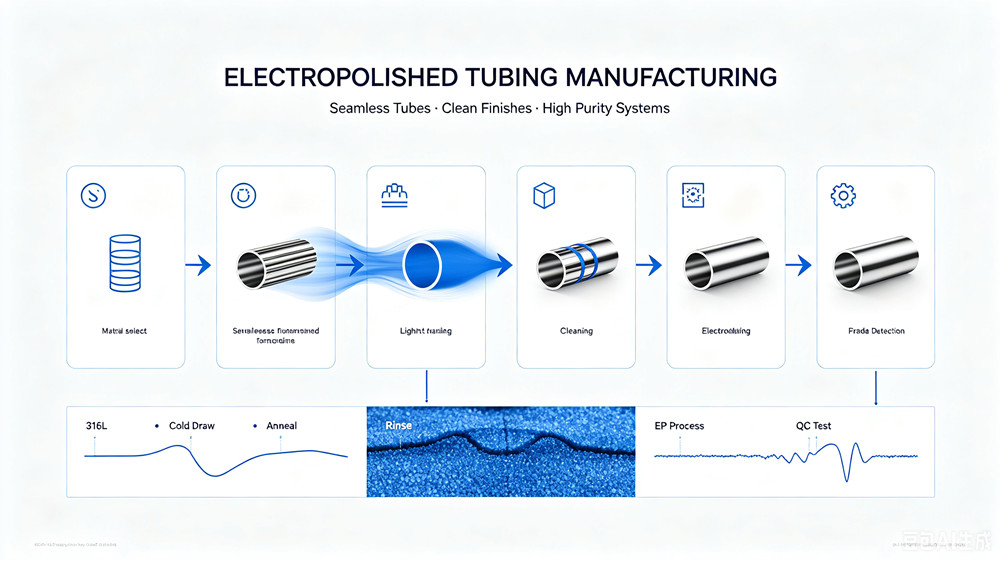
EP tubing is manufactured by producing seamless stainless steel tubes, followed by cleaning, bright annealing, and electropolishing. Electropolishing is an electrochemical process that removes a thin layer of metal from the internal surface and external surface of the tubing. This process reduces surface roughness, improves corrosion resistance, removes embedded contaminants, and creates a clean surface suitable for ultra high purity applications.
EP tubing refers to electropolished stainless steel tubing that has undergone an additional finishing process after manufacturing.
Most EP tubing is produced from seamless tubes made from 304L or 316L stainless steel. After the tubes are manufactured, they undergo electropolishing to improve the surface finish and cleanliness.
The finished product is widely used in systems where particle control and contamination prevention are important.
The manufacturing process begins with high-quality stainless steel.
The most common grades include:
The chemical composition of the material directly affects:
Manufacturers inspect incoming materials and verify that they meet applicable industry standards before production begins.
Most EP products begin as seamless tubes.
Unlike welded tubing, seamless tubes are manufactured without a welded joint.
The production process generally includes:
These processes produce precise dimensions and uniform wall thickness.
Seamless tubing is widely selected for semiconductor manufacturing and pharmaceutical systems because of its excellent pressure performance and dimensional consistency.
After cold processing, the tubing undergoes bright annealing.
Bright annealing is performed inside a controlled atmosphere furnace.
This heat treatment:
The surface is protected from oxidation during this process.
Before electropolishing, the tubing undergoes several cleaning steps.
Typical procedures include:
Removing oils and processing residues allows the electropolishing solution to contact the entire tube surface evenly.
The most important manufacturing step is electropolishing.
Electropolishing is an electrochemical process that improves the surface of stainless steel.
More specifically, electropolishing is an electrochemical process that removes microscopic peaks from the metal surface.
During the process:
Unlike mechanical polishing, electropolishing does not simply smooth the surface by abrasion.
Instead, it dissolves microscopic high points uniformly across the metal surface.
One advantage of electropolishing is removing embedded particles and surface impurities.
Manufacturing processes can leave behind:
Electropolishing helps eliminate these contaminants while improving the passive chromium-rich oxide layer.
This produces a cleaner surface for high-purity systems.
The internal surface is especially important for gas and fluid transport.
A rough internal surface may trap:
During electropolishing, the tubing undergoes controlled metal removal, producing a smoother internal surface.
This process reduces surface roughness, allowing fluids and gases to flow more efficiently while making cleaning easier.
One reason companies choose electropolished EP tubing is its excellent surface finish.
Surface quality is commonly measured using Ra (Roughness Average).
Typical values include:
| Tube Type | Typical Surface Roughness (Ra) |
|---|---|
| Mill Finish | 1.0–3.0 μm |
| Bright Annealed | 0.4–0.8 μm |
| Electropolished EP Tubing | 0.13–0.38 μm |
Because electropolishing reduces surface roughness, fewer particles remain on the tube surface.
Another advantage is improved corrosion resistance.
Electropolishing strengthens the passive oxide layer on stainless steel.
This protective layer helps resist:
Improved corrosion resistance contributes to longer service life and more stable system performance.
Semiconductor manufacturing requires extremely clean process environments.
Even microscopic particles may affect sensitive production processes.
For this reason, semiconductor facilities commonly use electropolished tubing for:
The smooth internal surface supports cleaner gas flow and easier system maintenance.
Many industries require contamination free process systems.
Electropolished tubing helps reduce:
This makes it suitable for:
Manufacturers typically produce EP tubing according to recognized industry standards.
Common standards include:
ASTM A269 covers seamless and welded austenitic stainless steel tubing for general service applications.
Used for sanitary tubing applications.
Widely used in pharmaceutical and biotechnology industries.
SEMI F19 specifies dimensional and quality requirements for stainless steel tubing used in semiconductor manufacturing.
Compliance with these standards helps ensure product consistency and quality.
After electropolishing, every batch undergoes inspection.
Common quality checks include:
Manufacturers may also provide Mill Test Certificates (MTC) and inspection reports upon request.
EP tubing is electropolished stainless steel tubing that has undergone an electrochemical finishing process to improve surface finish, cleanliness, and corrosion resistance.
EP tubing is manufactured by producing seamless stainless steel tubes, followed by bright annealing, cleaning, electropolishing, inspection, and packaging.
Electropolishing is an electrochemical process that removes a thin layer of metal from the tube surface, creating a smoother and cleaner finish.
The process dissolves microscopic peaks on the metal surface, producing a more uniform finish and reducing areas where particles can collect.
Its smooth internal surface, low particle generation, and contamination-free performance make it suitable for high-purity gas delivery systems.
Common standards include ASTM A269, ASTM A270, ASME BPE, and SEMI F19, depending on the application.
Yes. Electropolishing enhances the passive oxide layer of stainless steel, helping improve corrosion resistance in many operating environments.
The manufacturing of electropolished stainless steel tubing combines precision tube production with advanced surface treatment. Starting with high-quality seamless tubes, the tubing undergoes bright annealing, cleaning, and an electrochemical process that removes a thin layer of metal from the surface.
This process improves the surface finish, reduces surface roughness, enhances corrosion resistance, and supports contamination free performance. These advantages make electropolished EP tubing the preferred choice for ultra high purity UHP systems used in semiconductor manufacturing, pharmaceutical production, biotechnology, and other industries where cleanliness and reliability are essential.